
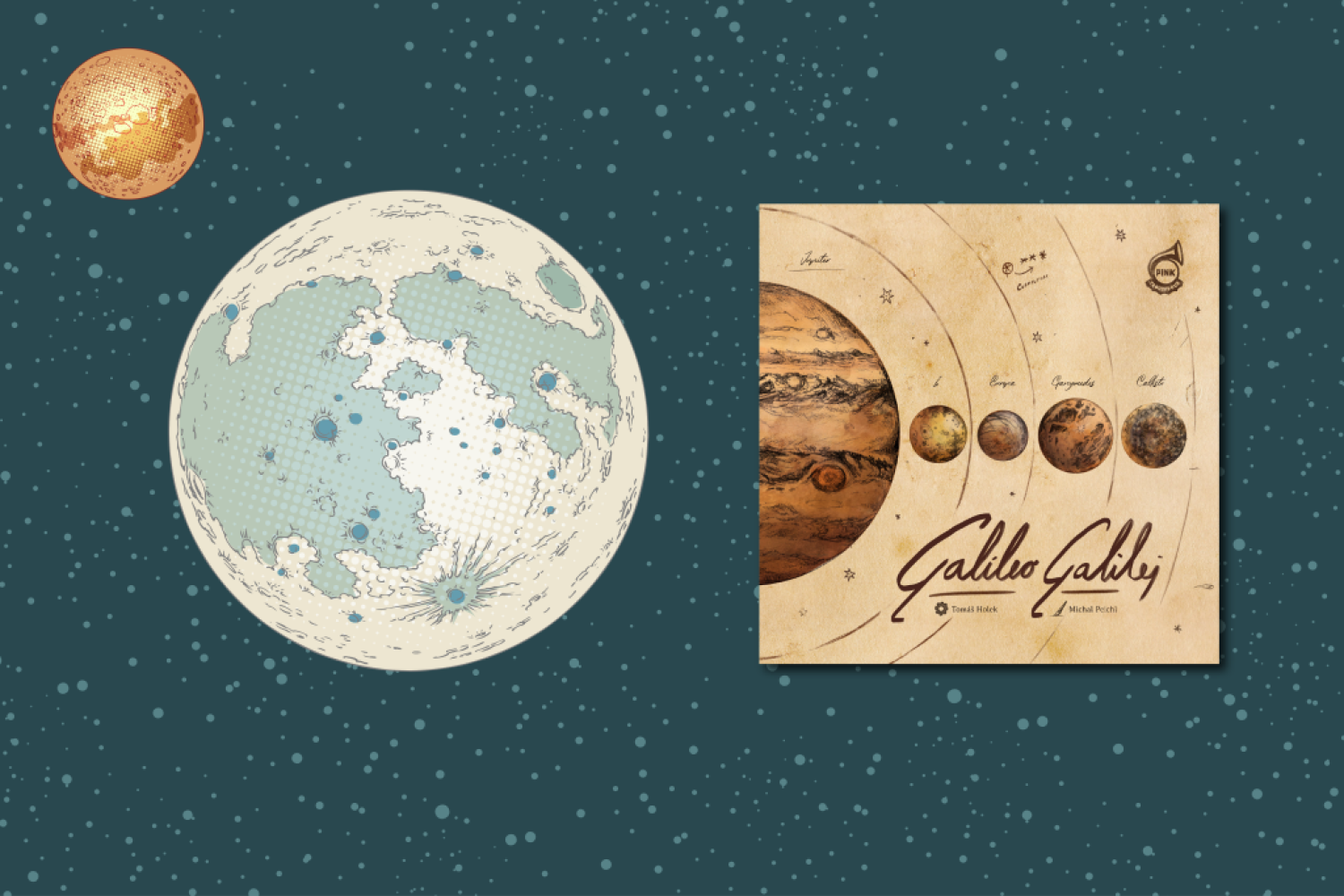
Galileo Galilei Review
I must confess I was totally influenced with my purchase of Galileo Galilei, as I had seen people playing it on Instagram and raving how good it was. I’m normally a tad sceptical but reading more about it, and seeing posts continue after the initial hype had died down, I put it on my Christmas list. Unsurprisingly, it arrived!
I logged my first play of it in February, and here we are in October, ready to tell-escope you all about it!
©boardgamereview.co.uk
Setup
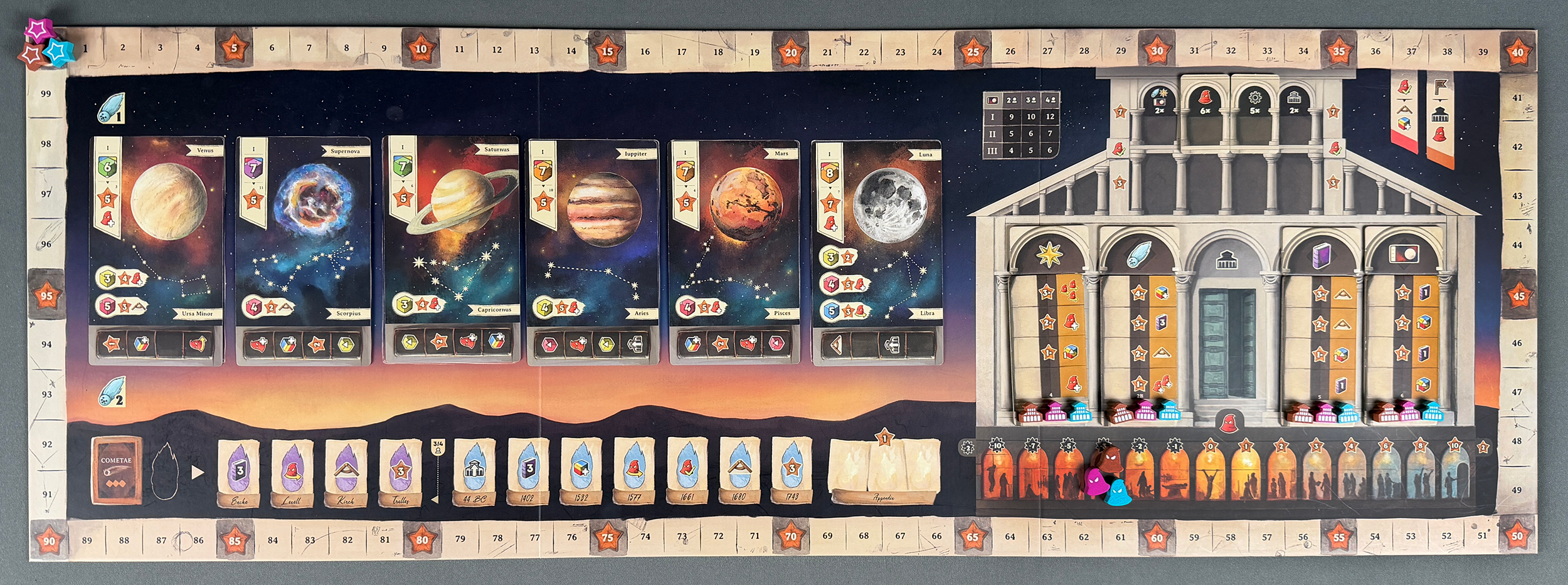
There is a bit to do in setup but it isn’t too laborious. The main board has to be unfolded. Cards selected depending on player count, and then once the draw deck is constructed, six cards are turned over face up in the correct place. Create the university tracks and contracts by overlaying tiles on the relevant spaces. Players place their score markers, university buildings and inquisitor tokens on the relevant places. Then, create a supply of dice, set squares and inquisitors in reach of all players.
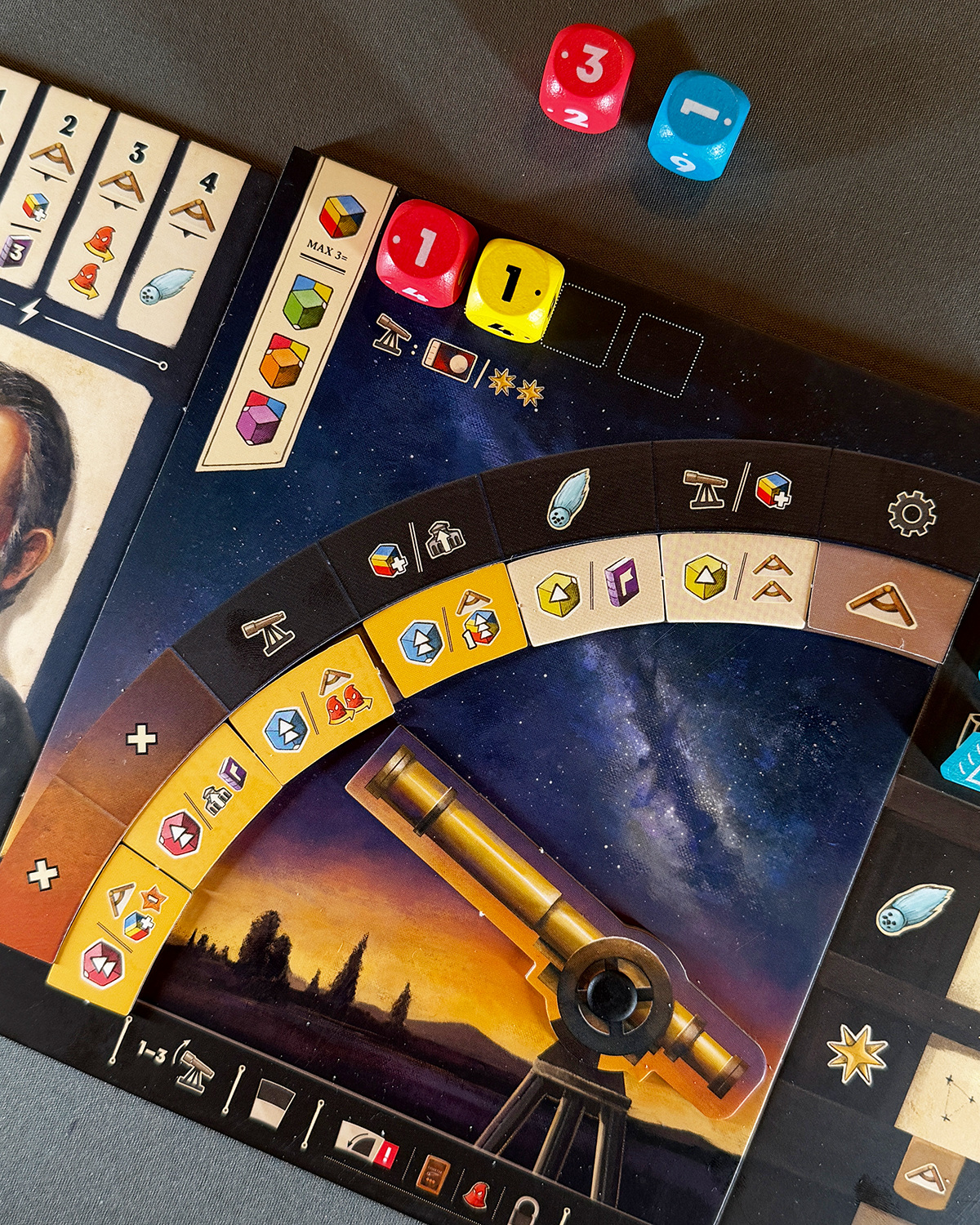
Randomly give each player an astronomer and choose to play with the asymmetric sides if you wish. This is added beside a player board, which needs to be populated with tiles around the telescope, comets, stars, books and starting dice of each colour. There is no home for the university contract markers so put them nearby, maybe on the face of your astronomer.
Finally, players take one of each colour dice and set it to number 1. Decide on a first player and you are ready.
©boardgamereview.co.uk
Gameplay
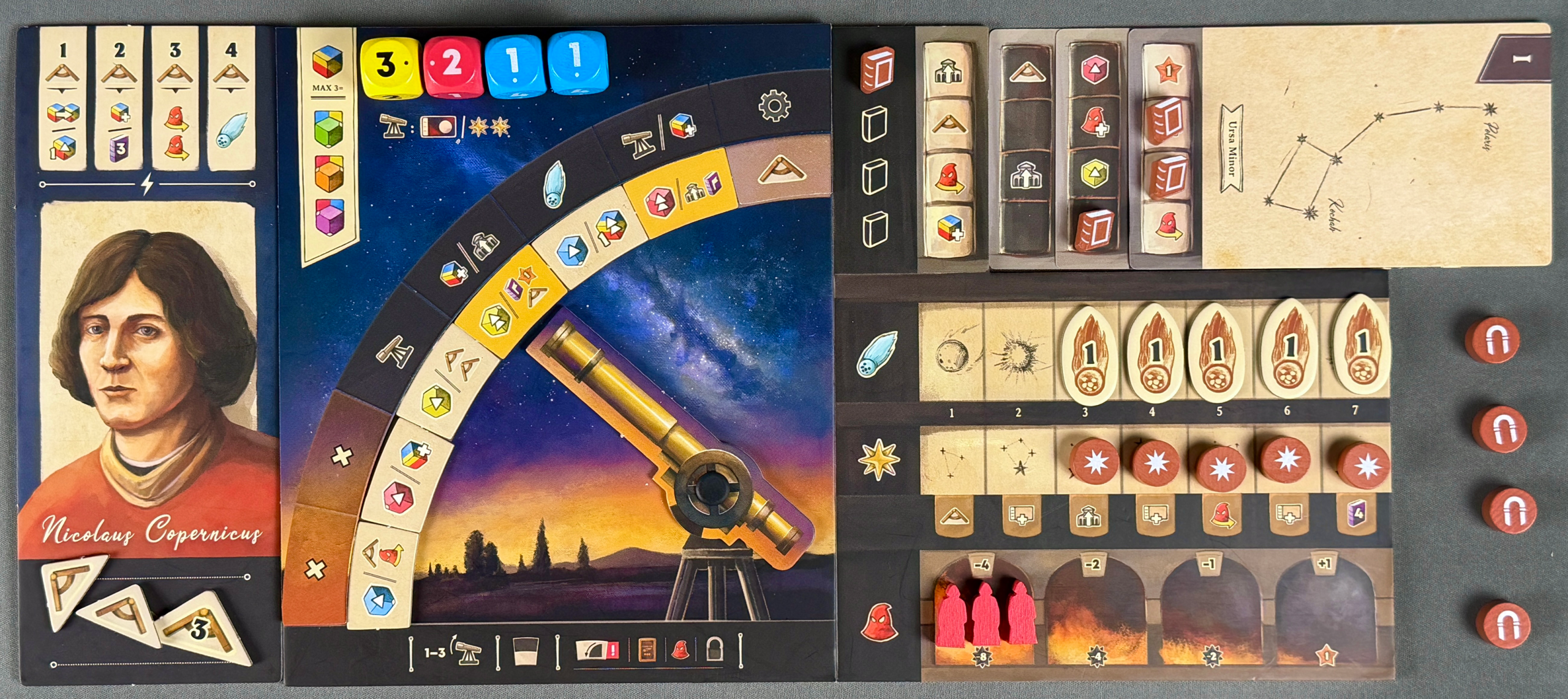
On a player’s turn they will move their telescope one to three spaces, carrying out the outer action and the inner action represented in the slot where their telescope finishes. These generally involve upgrading or collecting dice or carrying out actions on the main board. They can be performed in either order. The inner action then moves to the bottom of the track. The two actions at the bottom of the arch are blocked until they are shunted around by other tiles making timing of actions important.
Most things you do will earn you points or work towards end-game points. So over the course of the game you will be observing planets and stars by spending dice, gaining knowledge in the university, writing your findings in books, and keeping the inquisitors in check. All with the aim of having the most points at the end of the game, and thus become the winner! Imagine what a star you will be if you do that!
©boardgamereview.co.uk
What it’s like
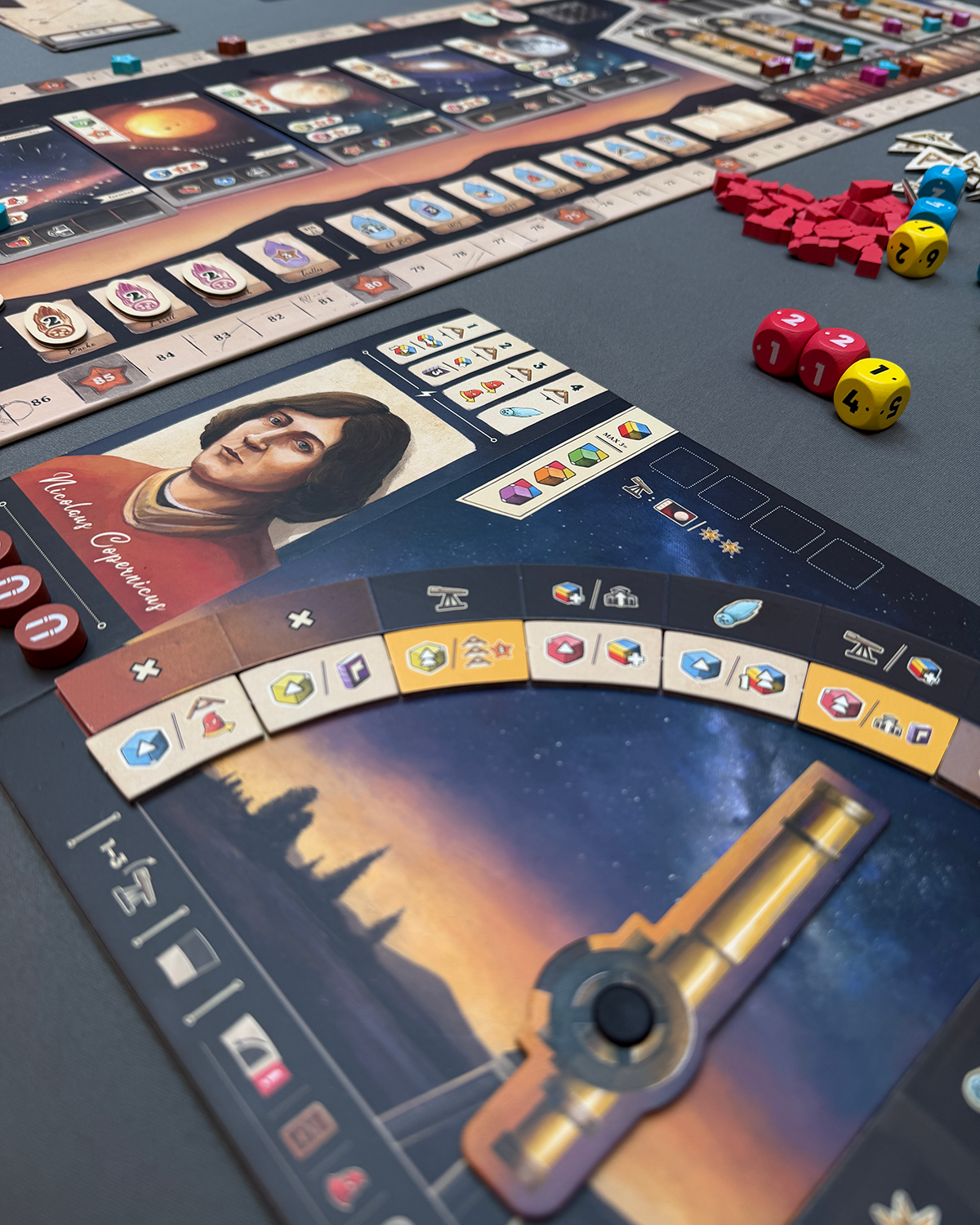
You have so many good options when playing this game, inevitably you cannot do them all. There is minor restriction from the ridiculously satisfying telescope rondel in what you can do that just involves a bit more planning than you might first give it credit for.
Other players can snaffle the planet or star you were after, or beat you to a contract, but the competition is a welcome addition. You are only everso hindered by your opponents yet it still adds to the tension. Some turns are super quick, while others create chains and combos that you can feel super clever for making happen.
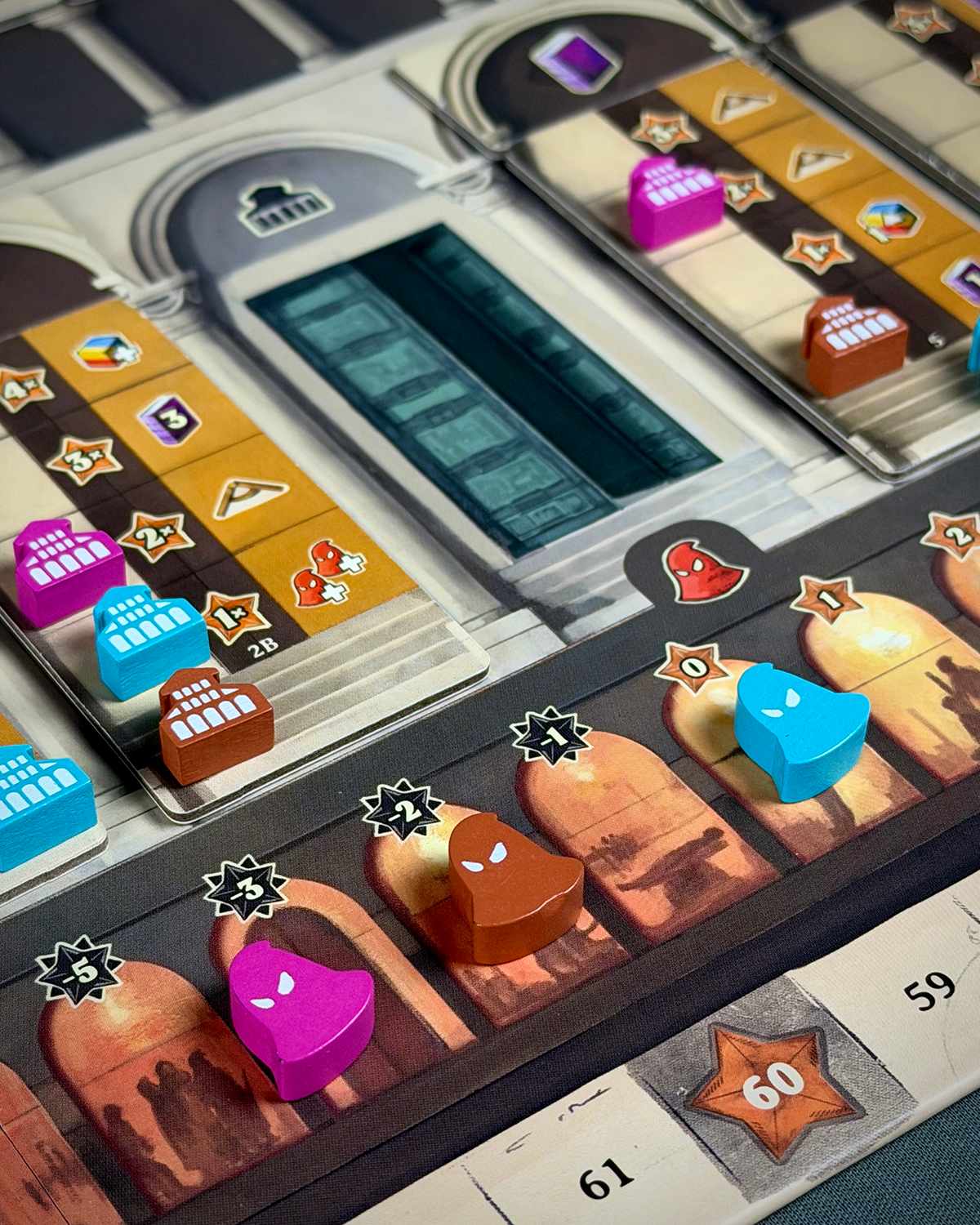
The inquisitors are total gits (I’ve called them worse), or at least they can be. They just need gentle persuasion that what you are up to is not heresy! Some might argue that they distract a bit from the core game. I disagree, I like that they are there making a nuisance of themselves and just thwarting your plans slightly along the way. They can be turned into big points if nurtured correctly too.
The gameplay really is excellent, especially if like me you enjoy climbing tracks, manipulating dice and creating combo chains.
It is on the heavier side of games that I have reviewed, but the game flows super smoothly it’s easy to pick up and teach once you’ve got a few plays logged and ironed out a few of the learning creases.
©boardgamereview.co.uk
Table Presence
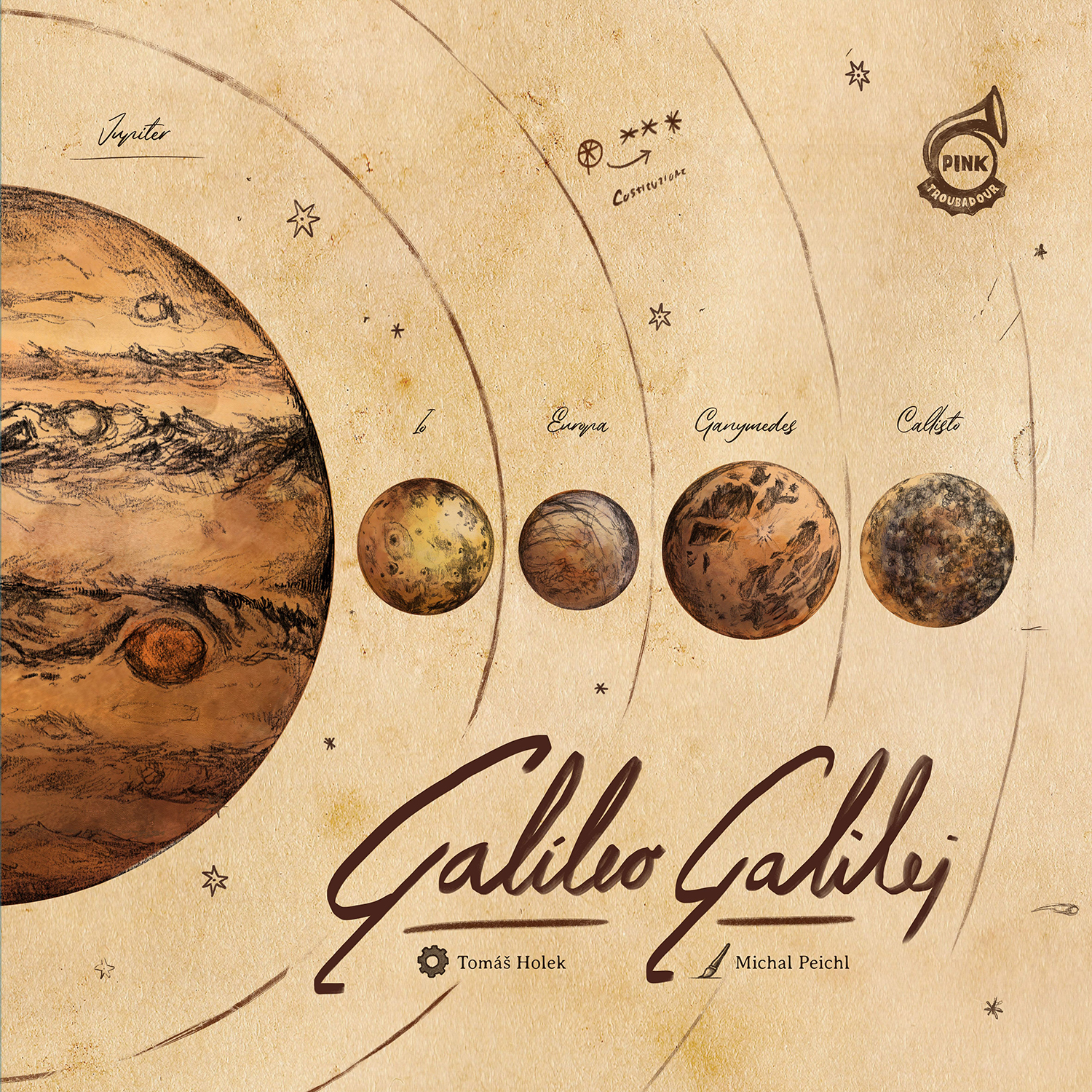
Galileo Galilie’s box art suggests this game could be a little beige. I think that partly adds to the feeling of it being set in the past. However, the main board once populated with cards and components make it quite attractive on the tabletop.
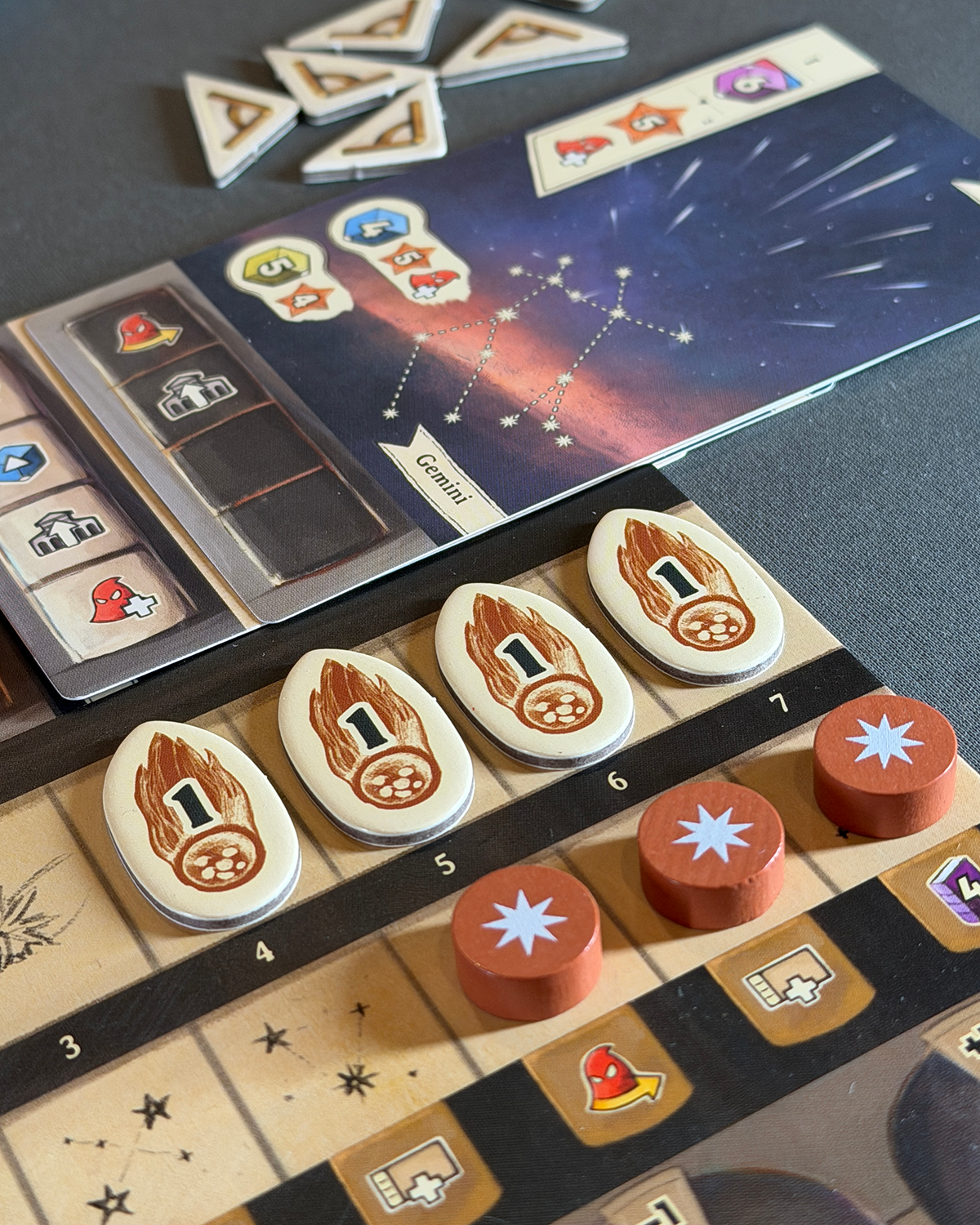
The player boards are also pleasant to look at, even though they are icon heavy. The revolving telescope is awesome. All the individual wooden components are of a good quality, although arguably come in unusual colourways. These seem to be consistent with Pink Troubadour games, but are questionable choices generally: blue, pink, brown and beige. Who wants to play as beige? I also think the brown and pink are difficult to distinguish in low light.
I am surprised there is no home for the university contract markers on either board as everything else has a nice little home.
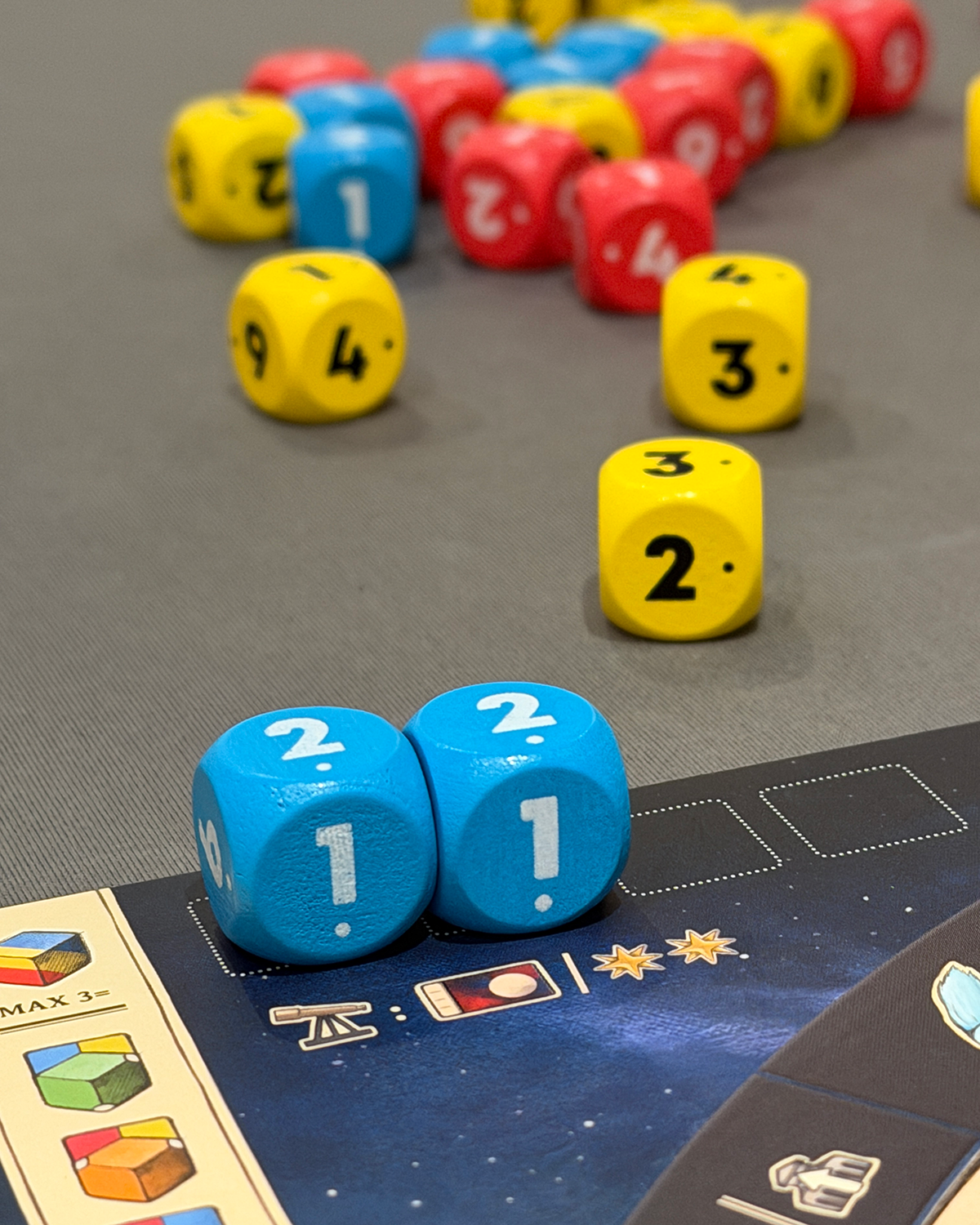
The cardboard resources are thick in a good way and the dice are colourful in their red, yellow and blue. These jolt slightly with the palette of the game as a whole.
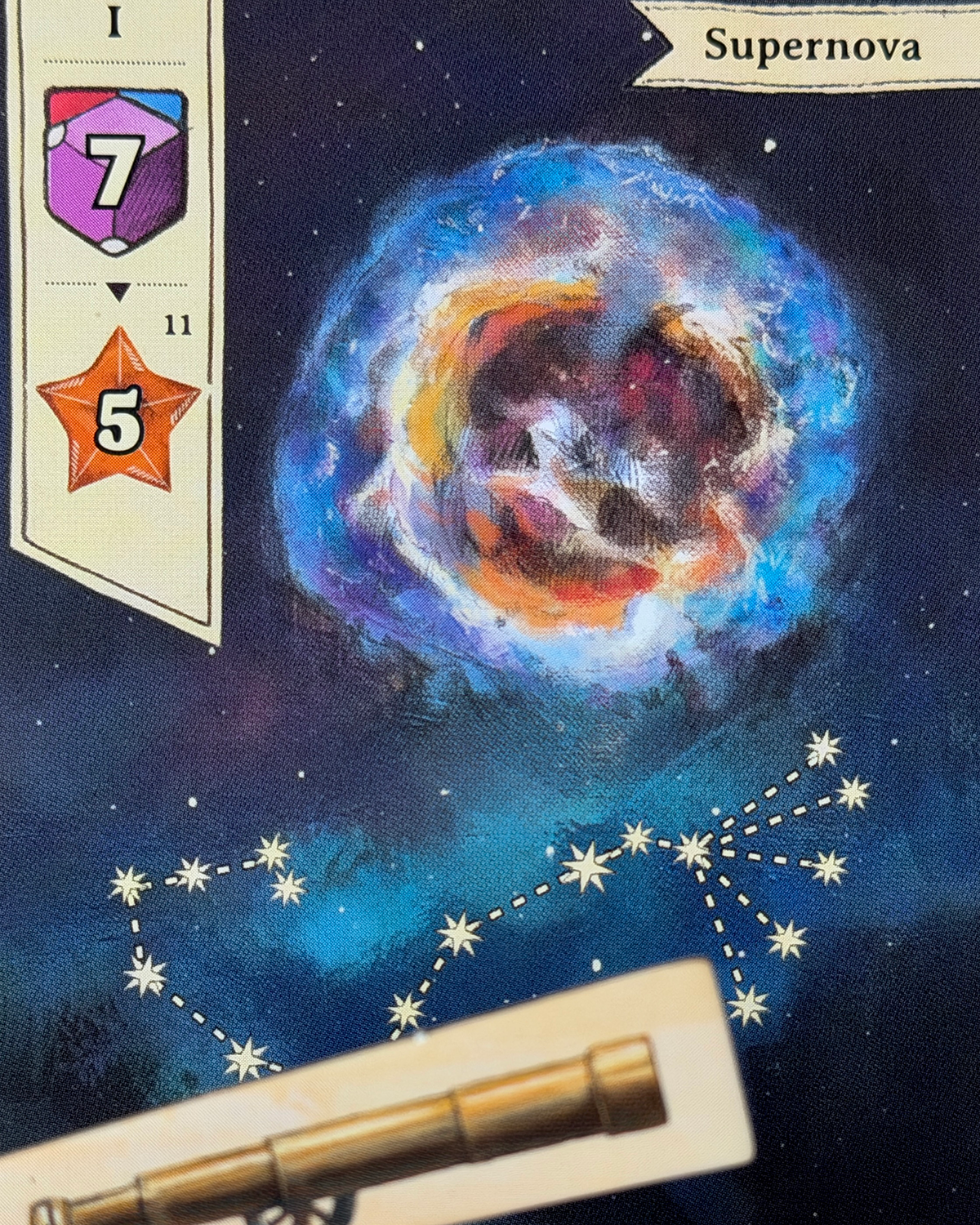
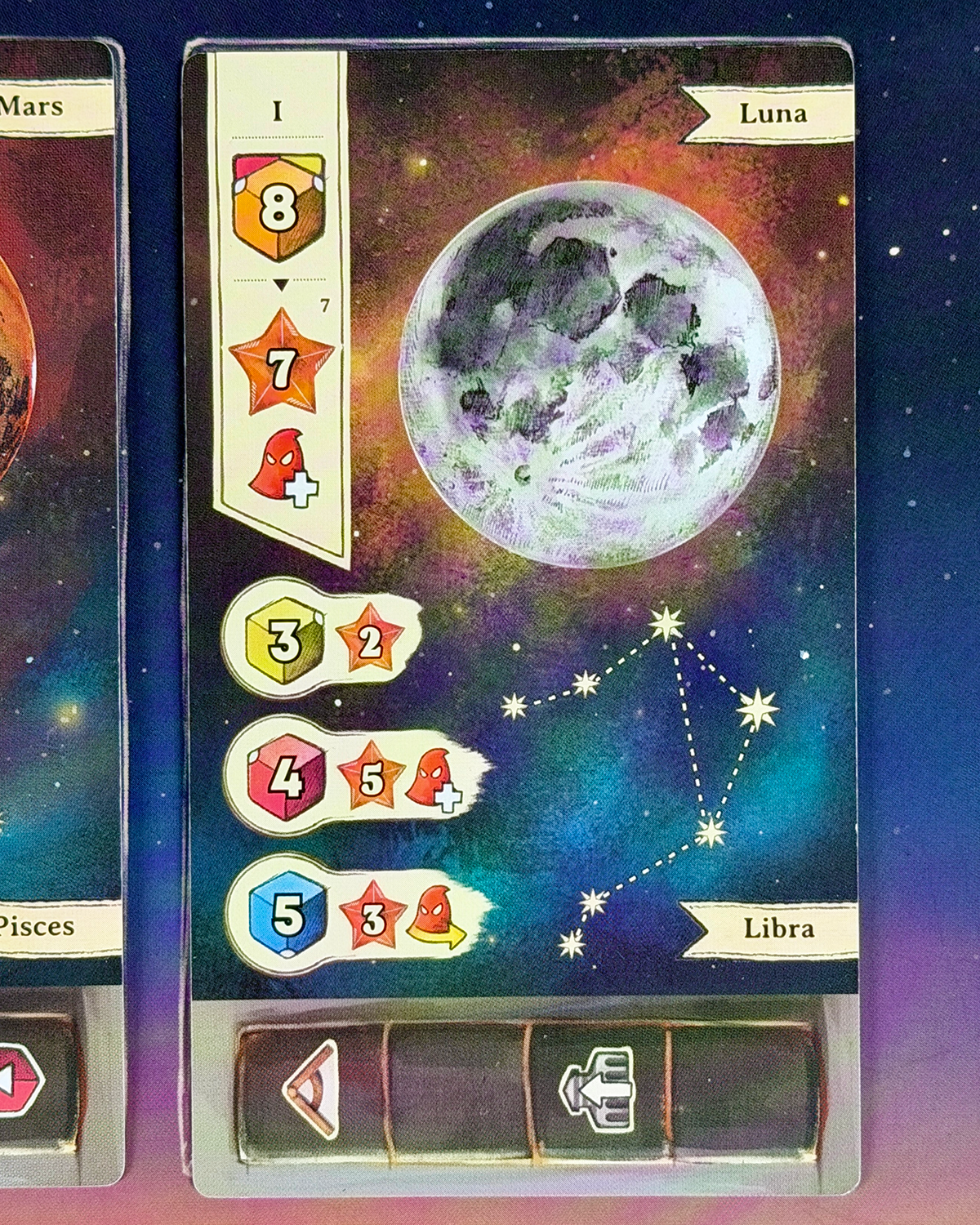
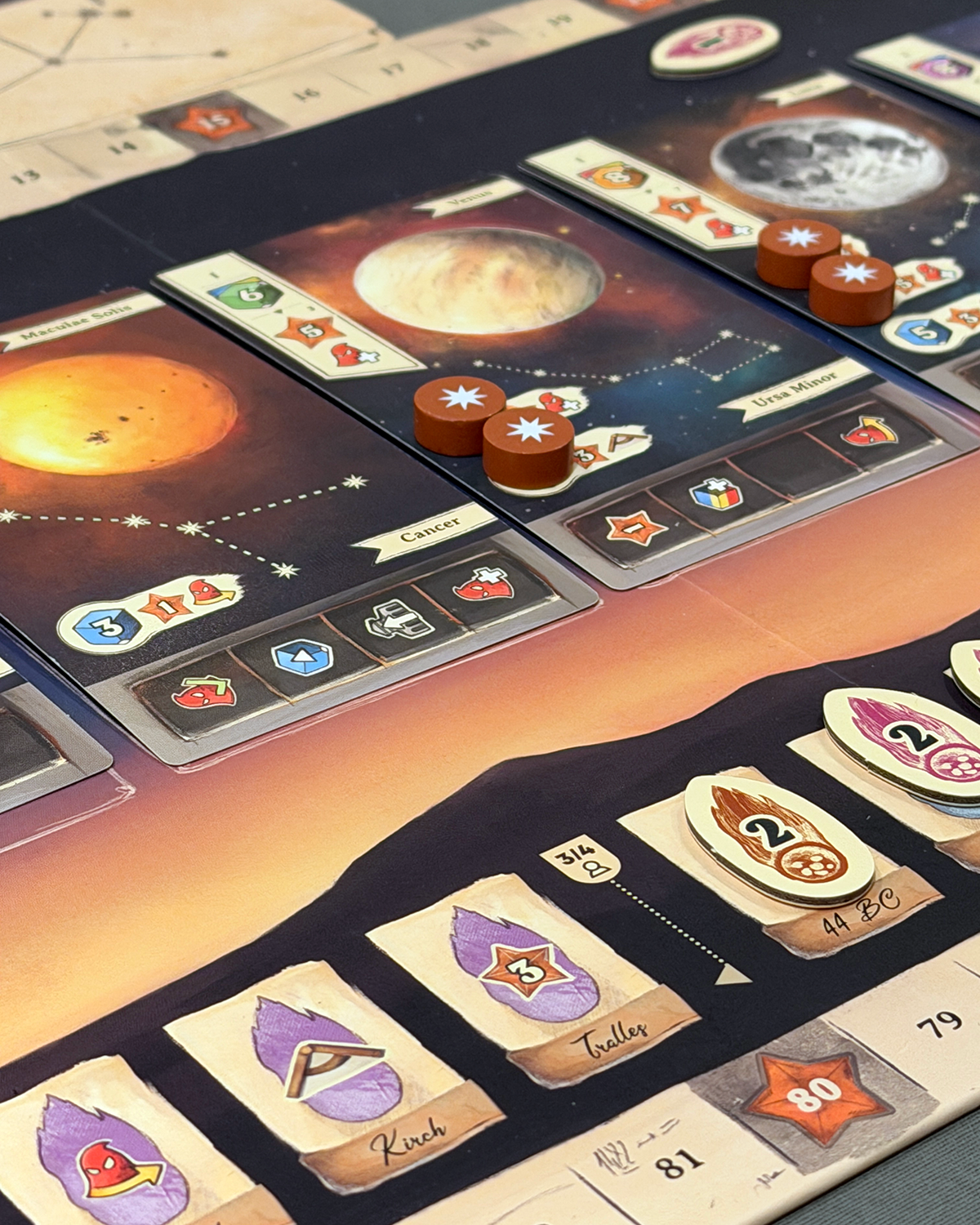
The card art is attractive and I love seeing the depictions of planets and other celestial bodies. I would also note the iconography is clear and consistent throughout.
One thing that is surprisingly bad is the box insert. My eldest son, Harrison, and I have joked how poor it is. In fact he has begged that I just throw it away and candidly the only reason I haven’t is because it winds him up so much!
The rulebook was generally very good, but boy oh boy did I struggle to get my head around the inquisitors, particularly when, how and if they had to move. I tried to get my head around it and played it wrong the first few times I got it to the table, weirdly though I played it differently wrong each time as I tried to interpret the words correctly. I think I have nailed it now – well I hope so anyway!
©boardgamereview.co.uk
Final thoughts on Galileo Galilei
After ten months of the year passing, Galileo Galilei is my third most played game of the year, behind the quick options of Agent Avenue and One Trip Nick. Having a heavier game being up there as one of my most played shows how much I have enjoyed this one. It may not be the most innovative, but I really think it is ruddy brilliant and ticks a lot of boxes for things I love in board games.
I know there are a few months left of 2026, but this is absolutely one of my favourite new-to-me games of the year. I just want to introduce it to more and more people and share the enjoyment I get from it.
©boardgamereview.co.uk
Key Facts
Number of players: 1 to 4
Board Game Review Recommended Age: 14+
Publisher’s Recommended Age: 12+
Playing Time: 90 minutes
Setting Up and Take Down Time: 5 minutes
Designers: Tomáš Holek
Publisher: Pink Troubadour
RRP: £67.49

Summary
I have been totally star-struck with Galileo Galilei and I still want to play it more and more! Although there is nothing new, the rondel, actions, tracks and dice resource management mesh together in an out of this world way!
-
Artwork and Components
-
Complexity
-
Instructions
-
Interaction
-
Value for Money
Overall
Pros
- Telescope rondel
- Good iconography
- Track climbing
- Chaining combos
Cons
- Inquisitors
- Colour palette on dice and components
- No home for University Track tokens
- The box insert
Need more games?
If you already own Galileo Galilei and enjoy it, or are looking for other inspiration, you might also like these similar games:
- Carl von Linné
- SETI
- Forestry
- The Druids of Edora
Buy Galileo Galilei
If you want to buy this board game after reading our review click on one of our affiliate links below (note there has been no affiliate links until this point)
Reviewer’s Note
For clarity: we don’t get paid for our reviews. I got this game as a Christmas present. While it would be a tad awkward if I hated it, I have tried not to let this affect our review in any way.
We may however earn a tincy wincy commission if you buy a game having clicked one of our affiliate links like the one above… this hopefully gives us a bit of pocket money towards hosting costs and new games to review!
As an Amazon Associate I earn from qualifying purchases.
We also are an affiliate of Board Game Prices, a price comparison website for Board Games.
These affiliate advertising programs are designed to provide a means for sites to earn advertising fees by advertising and linking to their websites.