
Koi Review
Advert: this game was gifted by DV Games, this has not affected our opinion.
I remember when I travelled to Essen for the European board game convention a few years ago, Bonsai was getting a heck of a lot of attention, selling out their limited stock early each day. I’d seen it, and while the gameplay appealed I couldn’t help thinking the game looked awfully brown and spindly. That didn’t tick the aesthetics for me so I resisted.
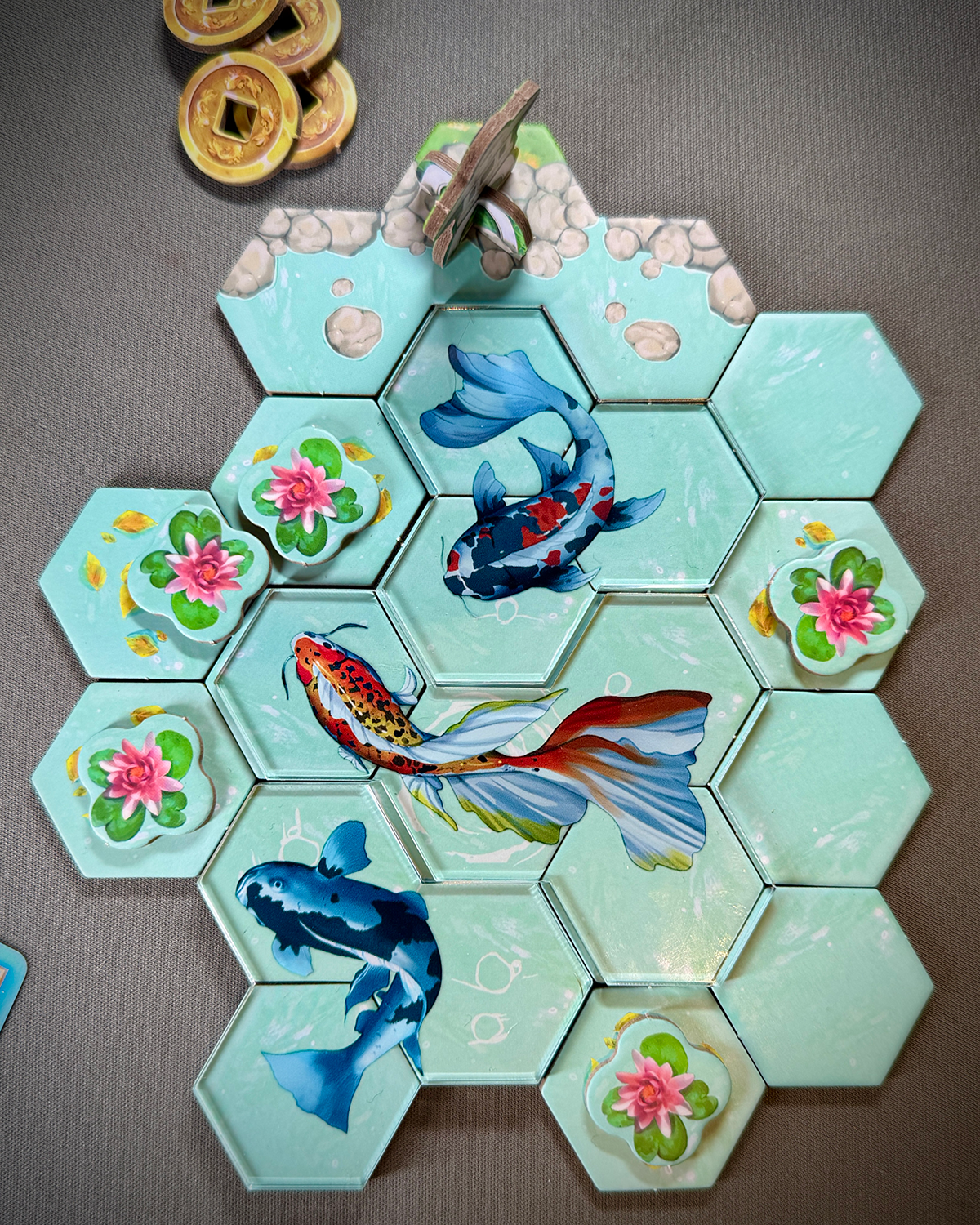
Imagine my excitement then, when Koi was announced. A game with similar mechanics to its predecessor, but with an aesthetic I could definitely get on board with. Building a pond with beautiful koi is definitely more my jam than a spindly bonsai tree! It’s a very pretty game. Of course you can’t judge it all on looks, and that’s why you are here – to read a review of the board game! So let’s get on with it, as it is going swimmingly so far!

©boardgamereview.co.uk
Setup
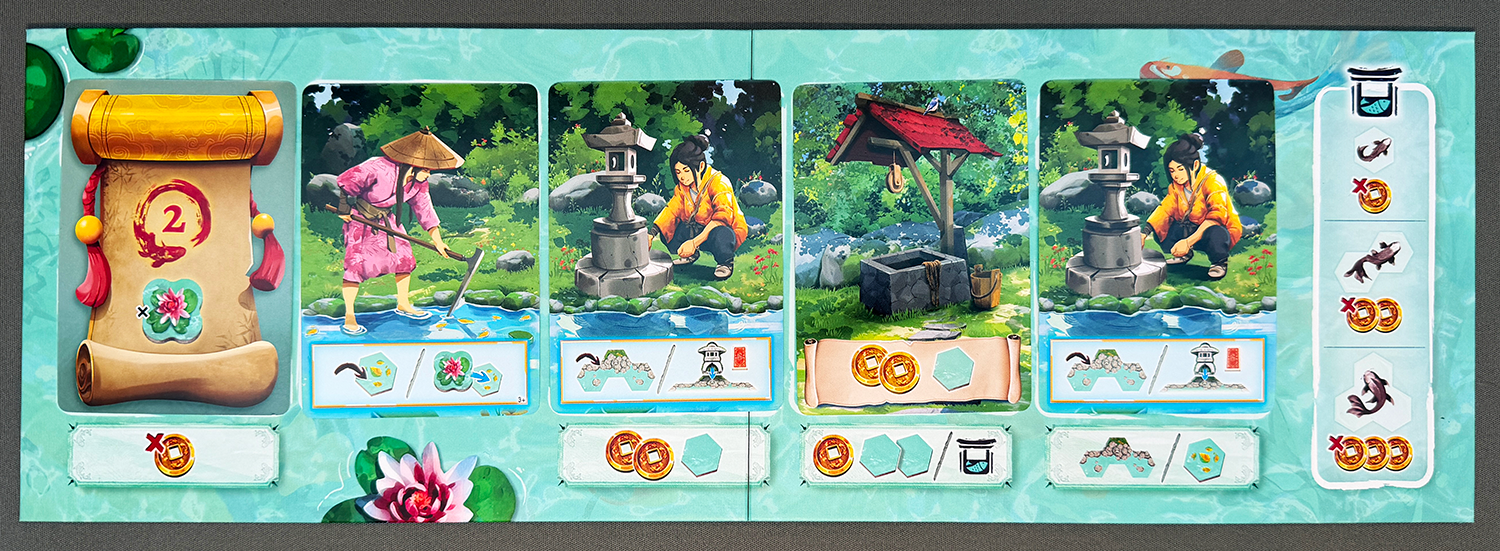
Empty the box and put all resources in piles, unfold the market board, shuffle the cards and lay out five cards face up to form the market. Every player needs a player board and a starting pond tile. Once a first player has been decided allocate resources to the other players as per the rulebook, including coins and a lucky token.
Finally, choose three bonus scoring objectives, the rulebook says to play your first game without these, but I think that is unnecessary and I launched straight in with them and have subsequently taught the game including them too. That is the set-up, you can now marvel at how pretty the koi and cards look.
©boardgamereview.co.uk
Gameplay
Over the course of the game you will build a pond full of beautiful koi, shaping it to maximise point scoring opportunities. Afterall, when playing Koi, most points wins!
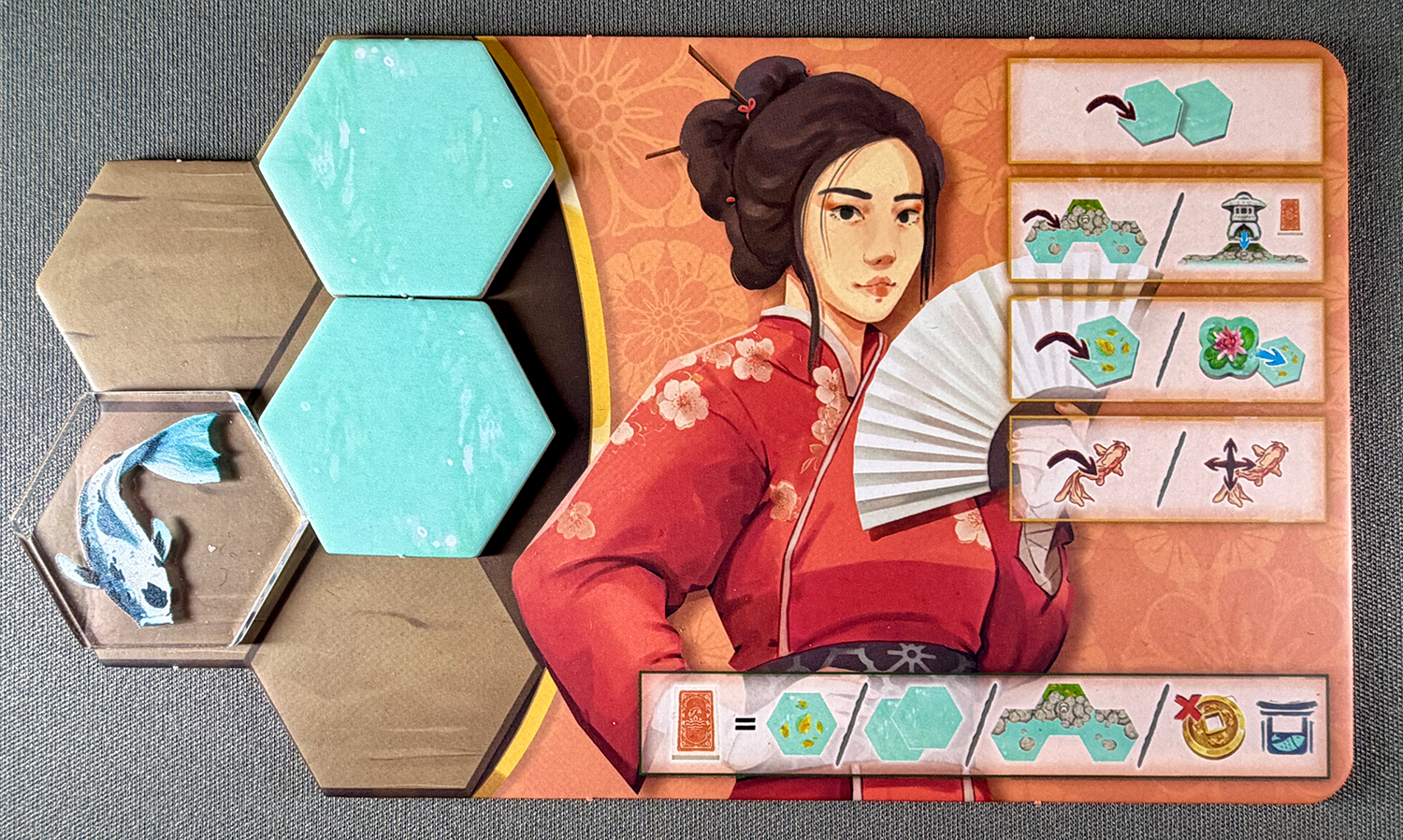
On your turn you will either Meditate or Work. Meditating involves claiming a card from the market and paying or gaining the associated bonus. Most things you gain have to be put into your personal storage before adding it to your pond, this can be restrictive, but a few cards can expand your storage area. Working allows you to move items from your storage to your pond, this could be water, leaves, shoreline or koi. Alternatively you can place a lily on a leaf tile, a mini temple on the shore or move a koi you placed earlier.
Basic points come from a few different things. Firstly, koi will score points depending on their size, and gain additional points if they are touching flowers. These points will be doubled if the fish is completely surrounded. Temples will score a point for every tile in a straight line from it.
Some cards from the market offer set collection bonuses, while the bonus objectives also offer a variety of points, depending on which three are chosen for the game.
The luck tokens, or as I call them “Lucky-Lucky Tokens”, are worth one point at the end of the game but can be used to acquire tiles too, which can be super handy at times.
©boardgamereview.co.uk
What it’s like
I know there is a whole section dedicated to table presence but I cannot wait to say that this game is very pretty. It also plays really smoothly and it combines familiar mechanics to create a game that is delightful to play. It still offers enough to think about too.
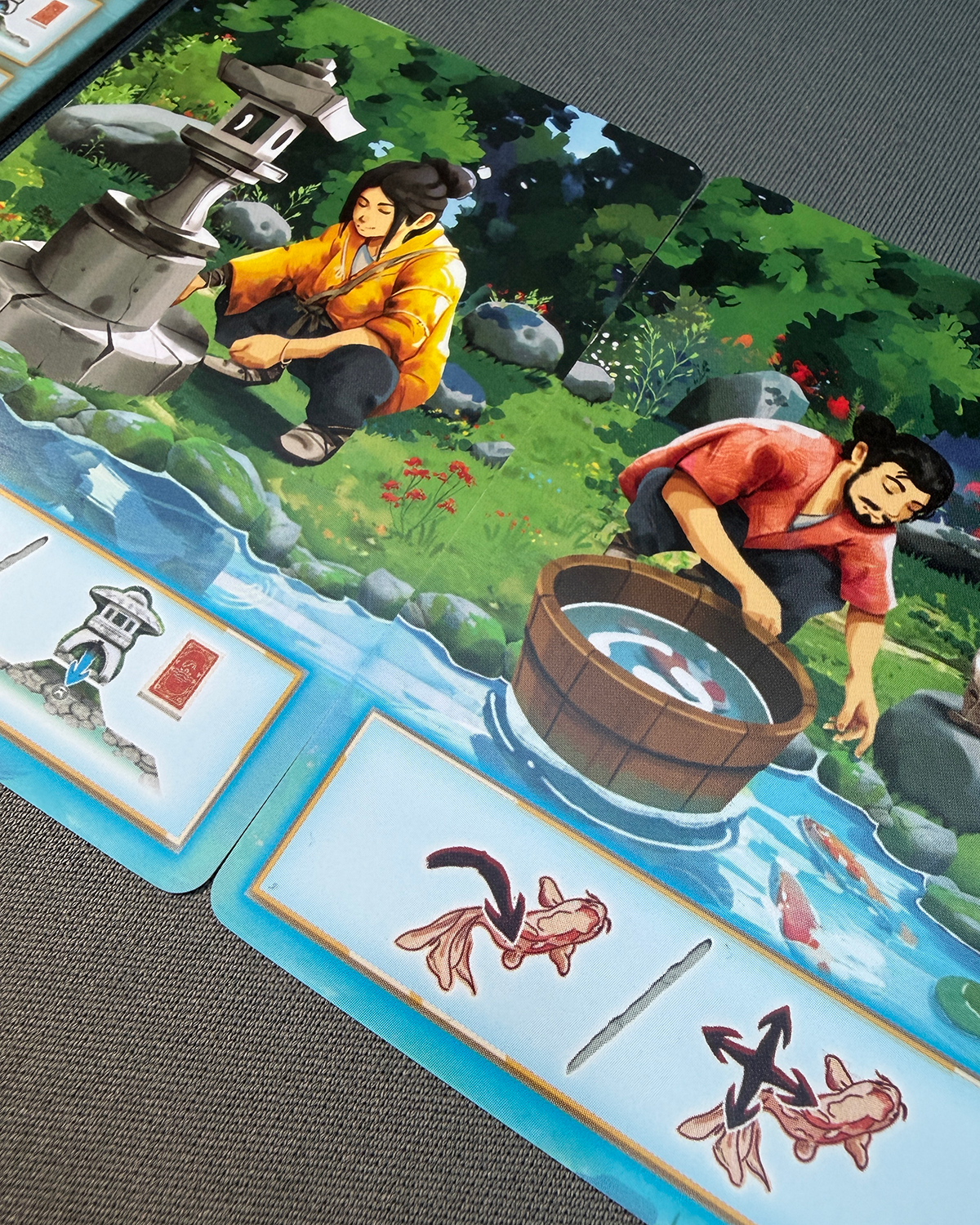
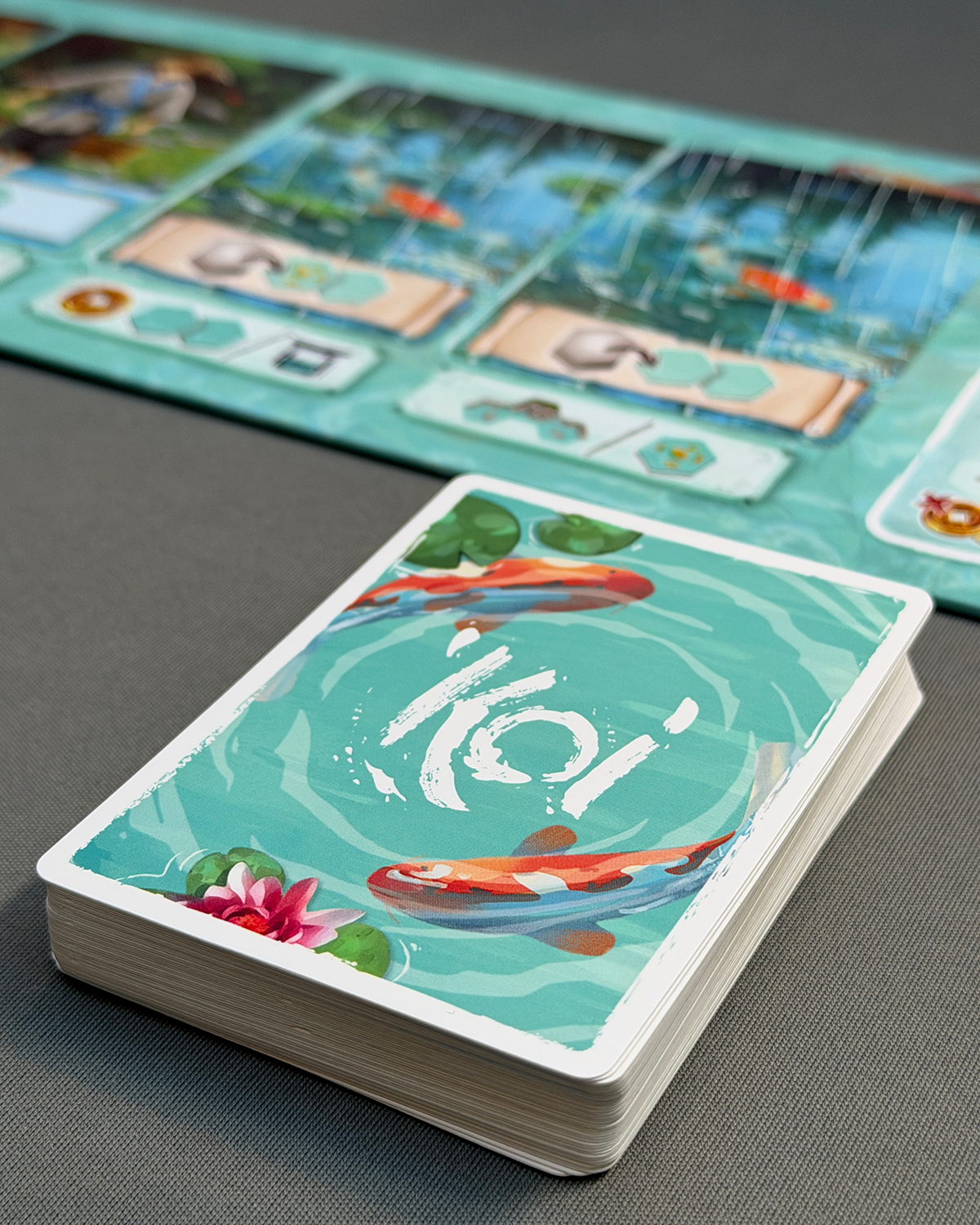
Koi gives me a similar feeling to playing Cascadia, or Century Golem, or Pergola. It is like playing a hug from a loved one. The market’s bonuses are better the longer a card is on it, as they move along as one gets chosen. It therefore offers up that lovely decision of getting one early because you want it, or waiting and hoping it is still there with a better bonus on the next turn.
All the cards are beneficial. The workers allow you to do more when you choose the work action and if these align with your strategy they can really help. Others give useful bonuses, and the scoring ones can really help win the game.
The work action can feel a little limited at the start of the game, but with worker cards this can allow you to do much more towards the end of the game. The storage area adds to this conundrum, as you only have a limited space for things to go before you have to take the work action.
One thing I have noticed is the temptation for people to take tiles from the supply and place them directly into their ponds before placing them in storage, I think this is because some items do get placed automatically and it just leads to some habitual errors.
Koi works at all player counts, but at two the market doesn’t always refresh quick enough, and at four there is a little bit of downtime between turns as planning is limited until you know what cards other player’s take. It isn’t significant from my experience but something to consider.

©boardgamereview.co.uk
Table Presence
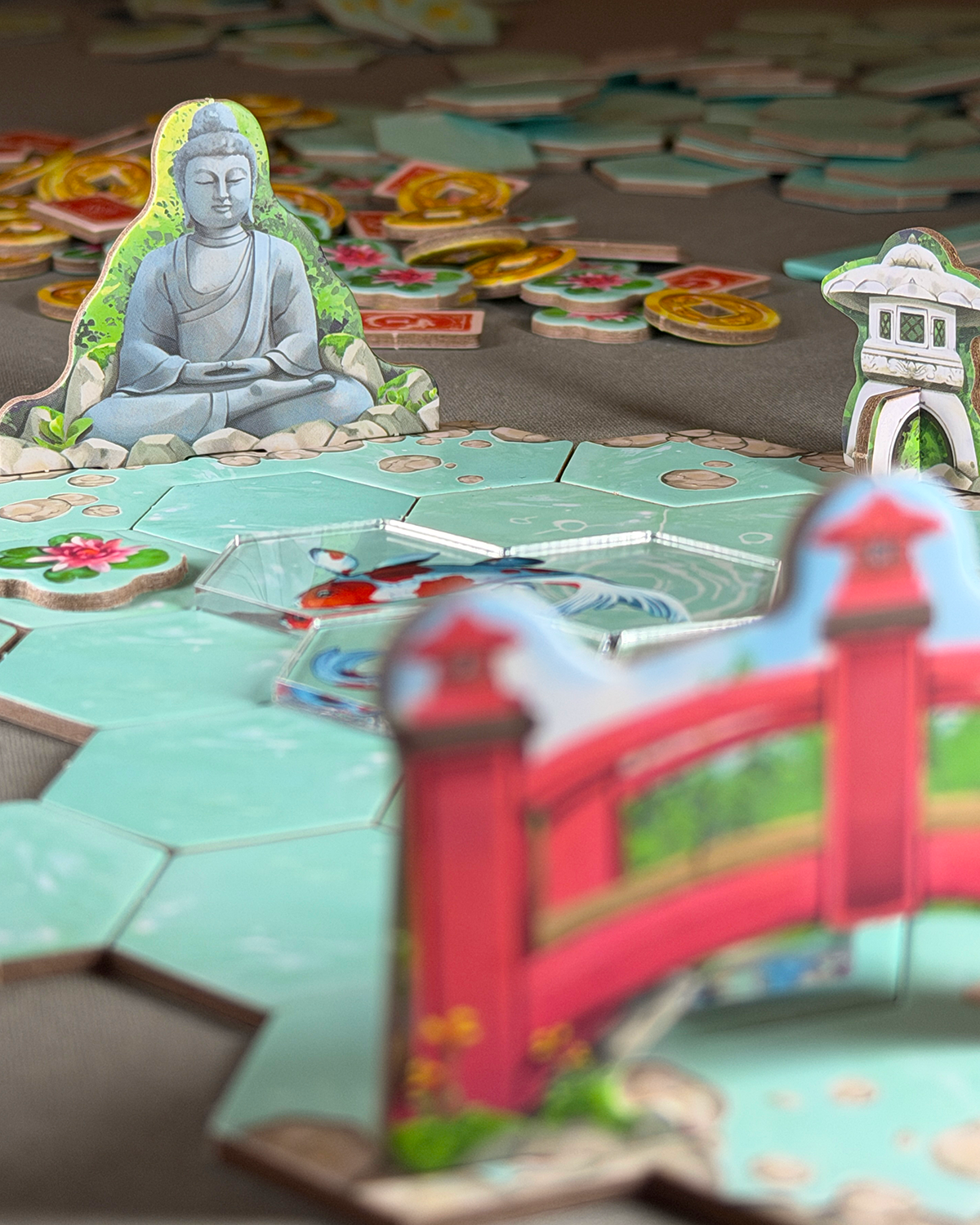
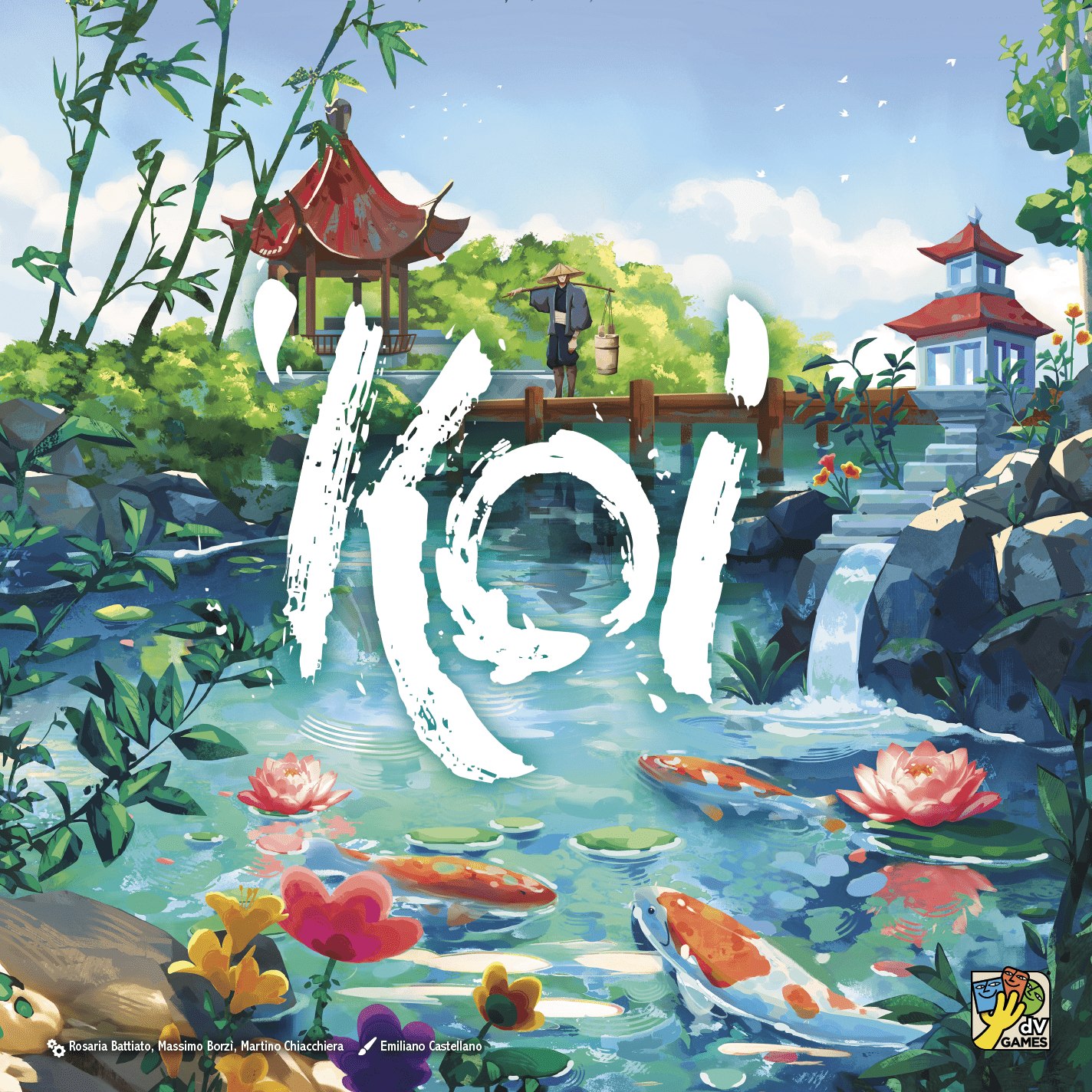
Have I said that Koi is a very pretty game? Well, in case I need to reinforce this for a fourth time, Koi IS a very pretty game. Not only is the box art tart in me incredibly happy with the externals, lifting the lid reveals more loveliness.
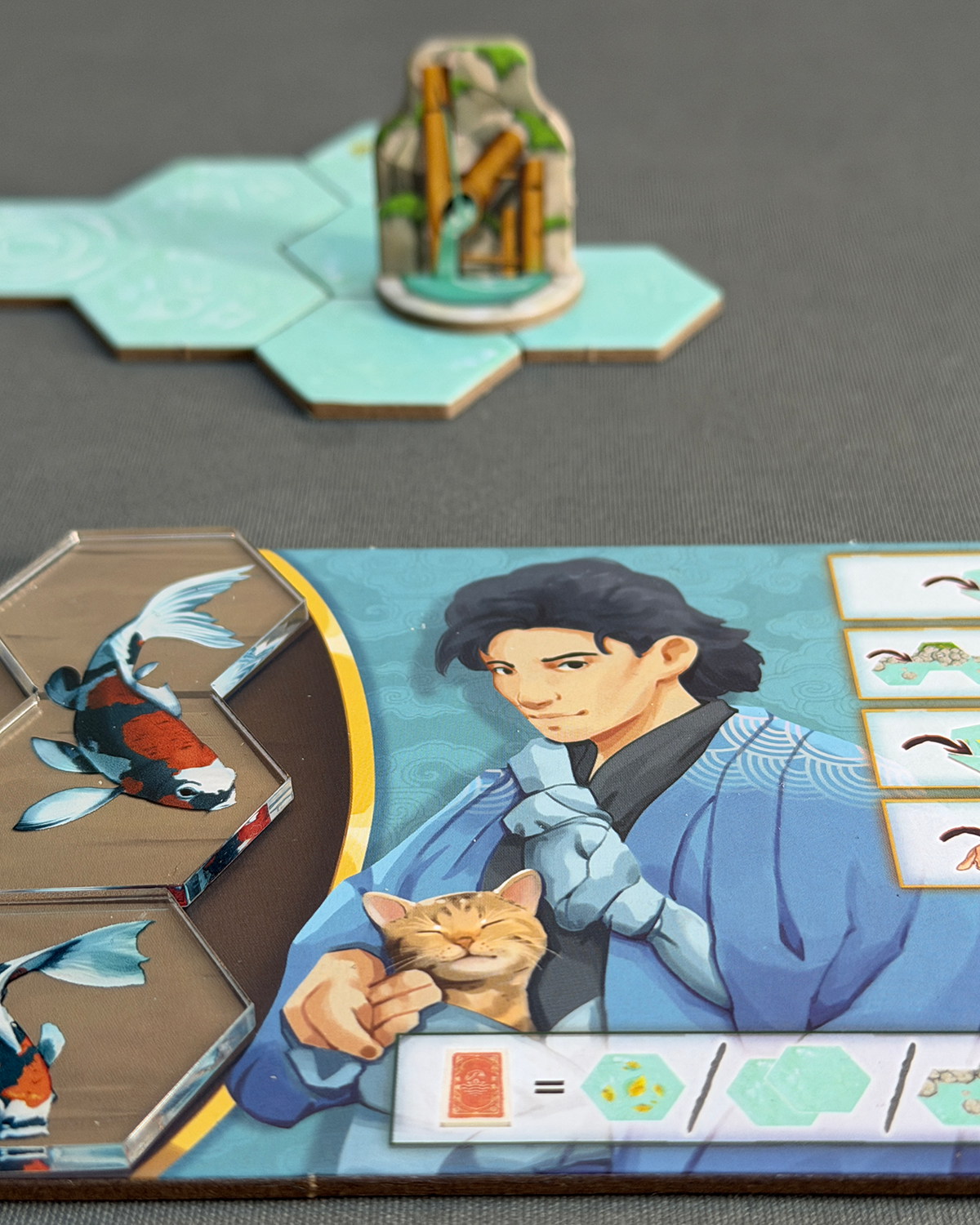
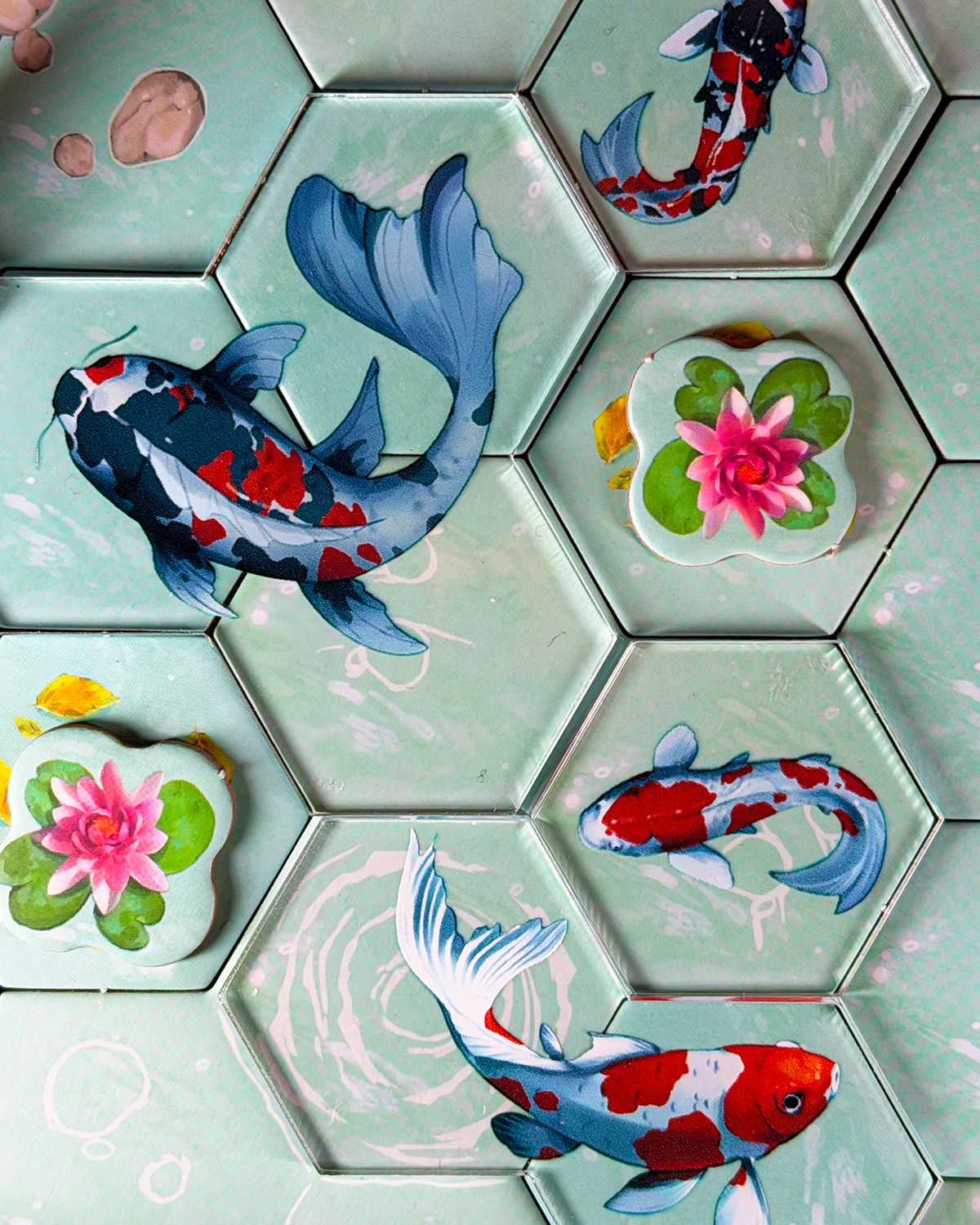
Now I am not usually a fan of acrylic creeping into board games, mainly because I hate peeling the film of them and also, it is just more plastic in the world. However, the acrylic tiles work really well and zing on the tabletop, so this is definitely an exception to the rule.
The cards are delightful and the cardboard is nice and chunky too. The three-dimensional nature added with temples and some of the bonuses create a beautiful table presence.
If I were to have the smallest of niggles it is that there is no insert inside the box. so I find myself dismantling bonus items for safer storage.
The rulebook was clear and concise, but there is a Rodney Smith ‘How to Play’ video available for those that prefer to learn that way.
©boardgamereview.co.uk
Final thoughts on Koi
If you haven’t realised yet, Koi is a very pretty game. Looks aside, there is a lovely game to play too. The quandary of the card market and the timing of taking your work actions offers a lovely decision-making puzzle. It is a lighter game, and as such may not be the main event. However, at either end of a board game night or as a midweek option when you are already a bit tired after the working day, Koi is a very good choice.
I’m a sucker for a tile layer and this is a lovely exponent of the mechanic with enough to think about to keep me engaged. There really is a lot to like about Koi.
©boardgamereview.co.uk
Key Facts
Number of players: 1 to 4
Board Game Review Recommended Age: 12+
Publisher’s Recommended Age: 10+
Playing Time: 45 minutes
Setting Up and Take Down Time: 4 minutes
Designers: Rosaria Battiato, Massimo Borzì, and Martino Chiacchiera
Publisher: DV Games
RRP: £38.99
Summary
I might have mentioned that Koi is a very pretty game! It really is, but I like the gameplay behind the beautiful façade too. It is a delightful game.
-
Artwork and Components
-
Complexity
-
Instructions
-
Interaction
-
Value for Money
Overall
Pros
- It’s a very pretty game!
- Tile laying puzzle
- Changing card market
- Several different bonuses to mix up games
Cons
- Too similar to Bonsai
- No storage insert
- Peeling film off acrylic
Buy Koi
If you want to buy Koi after reading our review click on one of our affiliate links below (note there has been no affiliate links until this point)
Reviewer’s Note
For clarity: we don’t get paid for our reviews. However, we were kindly gifted this game by DV Games. We have tried not to let this affect our review in any way.
We may however earn a tincy wincy commission if you buy a game having clicked one of our affiliate links like the one above… this hopefully gives us a bit of pocket money towards hosting costs and new games to review!
As an Amazon Associate I earn from qualifying purchases.
We also are an affiliate of Board Game Prices, a price comparison website for Board Games.
These affiliate advertising programs are designed to provide a means for sites to earn advertising fees by advertising and linking to their websites.